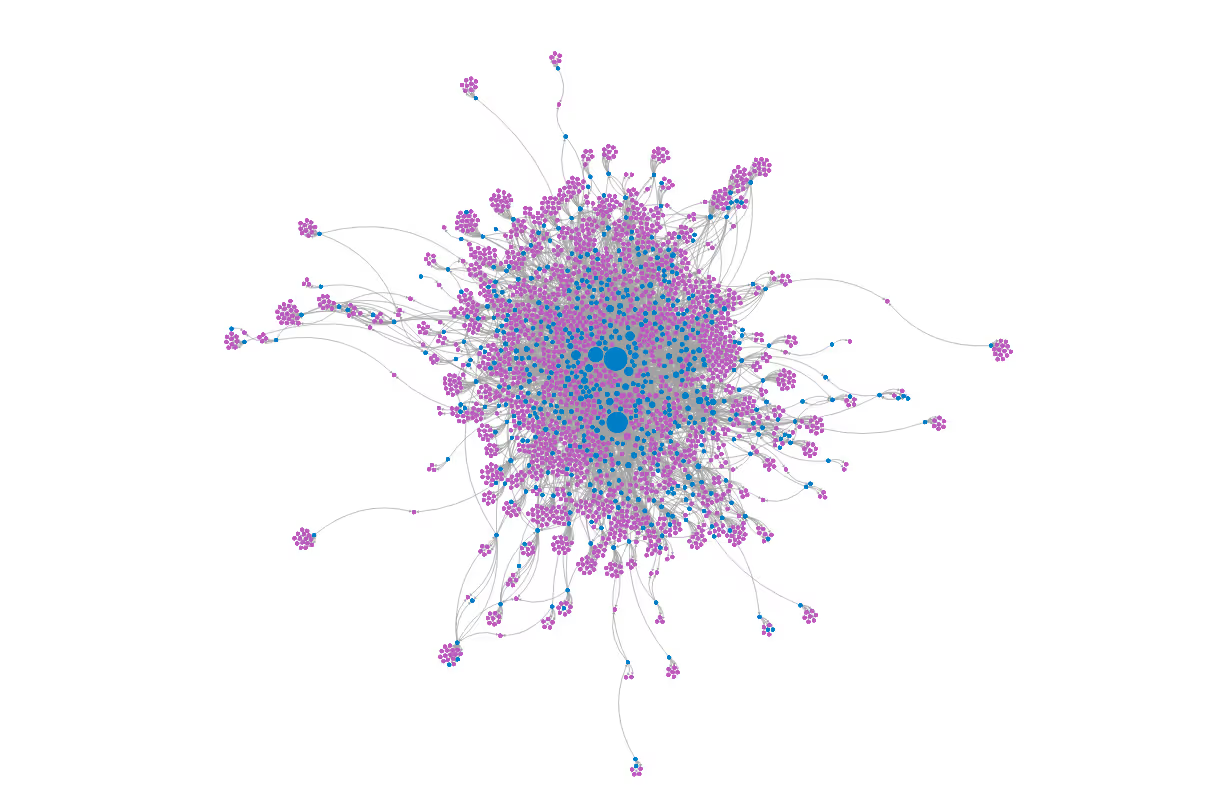
Organizational network analysis (ONA) is an incredibly powerful tool and, when used correctly, is capable of answering some of the most important questions about how your company is actually functioning (or not functioning), for example:
- Who really connects two teams?
- Where does information flow freely, and where does it get stuck?
- Who is really driving the culture of your organization and has outsized influence?
- What would happen if one of these (often) hidden influencers leaves tomorrow?
Traditionally though, getting those answers has required a fair bit of interactive data exploration and, in order to generate the most powerful insights, some expertise in network analysis. Generally, you need to know which network metrics to calculate, how to interpret the results, and how to translate network science into business insight that actually drives action and change. Even with a powerful ONA tool, such as Polinode, there has often been a gap between having a question and finding the answer.
A general-purpose AI assistant can certainly help guide the analysis and exploration of the data but…it’s just that, general-purpose and not specifically designed for ONA. What if there was a powerful tool that allowed you to just ask questions about your network?
Introducing AI Networks Chat
Today, we're launching AI Networks Chat—an agentic AI assistant built directly into Polinode. It allows you to ask a question in plain English and to then get an expert-level answer in seconds. Importantly, it’s more than just a chat bot - it’s an agent with access to network tools. That is to say, when you ask a question, the AI autonomously decides what tools it needs to answer that question and then executes that plan. It can automatically select a group of metrics to calculate, search the network for specific nodes and edges, perform aggregations across the networks, find shortest paths, and much more. It does all of this without you needing to specify the technical details.
The best part, you are still able to leverage Polinode’s powerful active and passive Organizational Network Analysis capabilities. That means you can design fully customisable Active ONA surveys and/or plug into passive data sources such as email, calendar and workplace collaboration tools - then leverage AI networks chat to make sense of that data once it’s in Polinode’s networks tool.
Why "Agentic" Matters for Network Analysis
The word "agentic" is getting thrown around a lot at the moment. Reading the predictions from large consulting and analyst firms alike at the start of this year pointed heavily to 2026 being the year of Agentic AI. “Agentic” has become a bit of a buzz word so it’s important to explain what we mean by it in this context.
Smart Context Retrieval
Your organizational network might have 10,000 nodes and hundreds of thousands of relationships. Traditional AI approaches would require feeding all of that as context—expensive, slow, and often impossible due to context limits. Retrieval Augmented Generation (RAG) helps but in most applications one loses the graph structure when applying it.
AI Networks Chat works differently. For example, if you ask "Who bridges Engineering and Product?" the agent intelligently queries only the relevant nodes, relationships, and metrics needed to answer that specific question. It retrieves context on demand rather than requiring it upfront.
Autonomous Tool Selection
The Polinode AI Networks agent has access to over 40 network metrics—betweenness centrality, eigenvector centrality, PageRank, community detection, boundary spanning measures, and more. Based on your question, it selects the right metric (or metrics) to calculate and it does so on the fly…..it might actually not calculate any additional metrics. If you ask about influence, it might calculate metrics such as betweenness and eigenvector centrality. If you ask about team cohesion, it may reach for density and clustering measures.
Multi-Step Reasoning
Many of us have seen just how powerful agentic systems can be - they are capable of planning and executing multi-step, complex processes. Polinode’s new AI Networks Chat is capable of answering complex questions by combining and planning multiple operations. For example, asking "Which department has the best external collaboration?" involves finding all departments, calculating boundary-spanning metrics for each person, aggregating by department, and comparing results. Polinode’s AI Network Chat chains these operations together, building toward your answer step by step.
Transparent Process
With a complex, multi-step process it’s important that the user (you) has visibility into the steps and the approach. That’s why we’ve made it possible for you to watch the agent work. Action logs show exactly what's happening: "Found 847 nodes... Calculating Betweenness Centrality... Filtering by Department... Aggregating results." It’s powerful but it’s also transparent.
What You Can Ask?
The short answer to this question is that you can ask quite literally anything. One of our favorite questions to ask is actually what questions to ask of the network - the AI will take into account what attributes you have on the nodes and edges and any additional context you provide it in order to suggest questions you may want to ask.
But let’s not get too meta, at least not yet. By way of a more concrete example, here are four example questions that demonstrate its flexibility:
Finding Key Connectors: "Who are the most influential people bridging our Engineering and Product teams?"
The agent calculates betweenness centrality, identifies people with connections spanning both departments, and returns a ranked list with context about why each person matters for cross-team collaboration.
Path Analysis: "What's the shortest path between Sarah Chen and Michael Torres?"
The agent runs a shortest path algorithm, traces the connection chain, and explains each intermediary. Finding the shortest path between two individuals has been a common feature request that we have heard quite a few times when talking to Polinode users. It’s now possible via the AI Networks Chat (and with added explanations and the ability to ask follow-up questions).
Comparative Analysis: "Which department has the highest average external collaboration?"
The agent calculates boundary-spanning metrics for everyone, groups by department, computes averages, and ranks the results. This gives you a clear picture of which teams are most connected to the broader organization.
What-If Scenarios: "What would happen to our network if the VP of Product left?"
This is one of the most interesting new capabilities we added alongside AI Networks Chat. When given a question like this, the agent simulates removing that node from the network, identifies who would become disconnected, and may also measure the impact on average path length, and highlight at-risk communication flows. This gives you the ability to simulate organizational changes before they happen.
Who Is it For?
People Analytics Teams: If Python or R is still your go-to for network analysis, we'd encourage you to consider what Polinode could add to your workflow. People Analytics teams we work with have seen significant reductions in time-to-insight, and we believe AI Networks Chat represents a step change — making it possible to explore and interrogate network data in ways that simply weren't feasible before.
ONA Consultants: One of the strongest reactions we have seen when previewing this functionality has been from our consulting partners, especially as we talked through the ability to share AI network chats with other users (e.g. you can ask the question and share the response with a client or vice versa). We’ve also seen a number of our consulting partners start to share access to the interactive networks in Polinode with their line of business customers - we expect that the ability to give access to AI Networks Chat to these business users will significantly increase the attractiveness of this option.
HR Business Partners: Historically HR Business Partners have not been big users of Polinode - we expect that may change though with AI Networks Chat. One of our goals for the functionality is to continue to democratize access to Organizational Network Analysis…and we have quite a few ideas for how we can continue to move forward in this direction.
Business Leaders: Business leaders have traditionally relied on People Analytics Teams or external consultants to act as a translation layer between raw ONA data and actions / insights. We believe that AI Networks Chat will help Business Leaders ask their own questions of the data more directly, while allowing People Analytics Teams and Consultants to focus on things like actually converting insights to action and change.
We Are Just Getting Started
Today’s announcement is a huge step forward, both for Polinode and, we think, for network analysis more generally. It’s important though to make the point that we are really just getting started - we have a lot of ideas for how we can continue to develop this functionality and make it even more powerful. We have also received a lot of feedback from users (and the community more generally) as we previewed this functionality. Thank you to all those who took the time to provide us with feedback and ideas - and we are always open to having more such conversations (you can reach out via info@polinode.com).
Try It Today
One of our aims at Polinode has always been, since the company was established almost 13 years ago now that is, to democratize organizational network analysis. For that reason this new functionality is designed for enterprise use but it’s not only available to large enterprises with equally large budgets. AI Networks Chat is available (albeit with a lower usage quota than our Enterprise accounts) on our Lite plan which starts at only US$40 / month.
All current Polinode paid users have AI Networks Chat included in their current subscriptions. For users of our Lite and Professional individual accounts, a moderate usage quota is now included in your subscriptions at no additional charge. All existing Enterprise and Consultant customers also have AI Networks Chat included in their existing subscription and can also purchase additional quota blocks if and when needed.
And, of course, if you work at an Enterprise or as a consultant to Enterprises, it would be our pleasure to give you a live demonstration of this functionality - please just reach out via this form or via email at info@polinode.com.

Andrew Pitts

Andrew Pitts is the Founder and CEO of Polinode, a leading provider of organisational network analysis software and solutions for enterprises. Andrew founded Polinode in 2013 and it is now used by large enterprises and consulting partners around the world for a variety of applications including: identifying emerging and/or hidden talent; improving collaboration; finding influencers; succession planning; organisational design; and diversity and inclusion. Prior to founding Polinode, Andrew worked in the Investment Banking Division of Goldman Sachs in both Sydney and New York. He enjoys working at the intersection of technology and HR and is passionate about using technology to help optimise and improve modern organisations. Andrew is a full-stack developer with experience building scalable web applications and also has deep expertise in data analysis and machine learning.

%20(2)_cropped_processed_by_imagy.png)